What Teaching Artists Know About Leading
The Leaders We Say We’re Looking For Are Already in the Field. We Just Built a System That Won’t Let Them Stay.
By Edie Demas
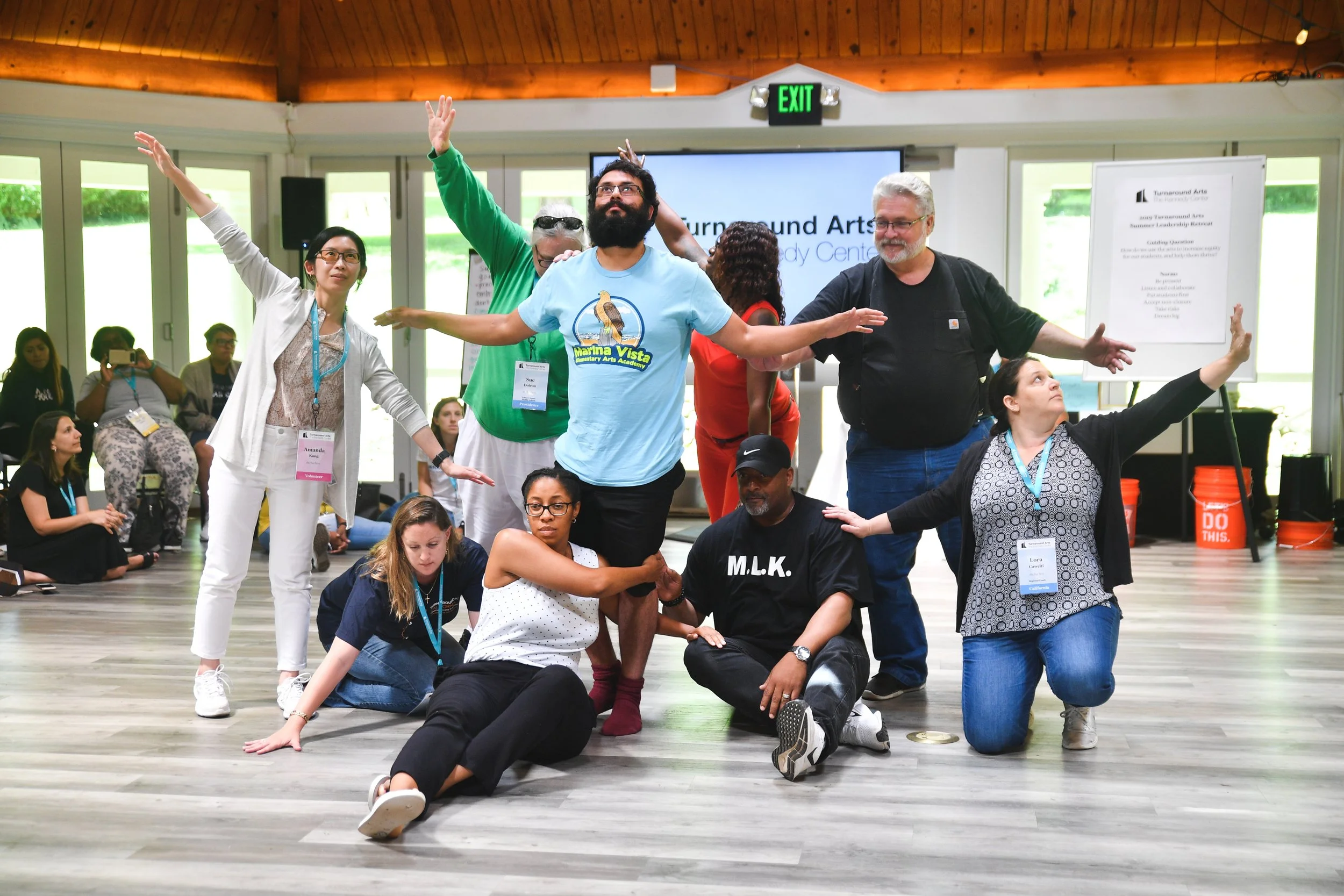
Photo credit: Turnaround Arts at the Kennedy Center
Teaching artists have been central to my career. I started as one myself, working in theater and film education in Ireland, where the term didn't exist. “Teaching artistry” was just another form of a creative gig. That’s a different blog post for another time perhaps, but an important distinction.
When I returned to the US I went on to build and lead a 40-person Teaching Artist Ensemble at the nonprofit New 42’s New Victory Theater in New York. Now, working in organizational strategy and executive search for arts and cultural organizations, I see how rarely institutions design for teaching artists as part of their core workforce. Two recent pieces crystallized something I've been thinking about for a long time.
Emil Kang's What We Owe Teaching Artists: The Profession We Refuse to Build lays out the structural economics with devastating clarity. According to the NYC Arts in Education Roundtable’s 2025 report, 79% of teaching artists say the work doesn’t provide enough income to live in New York City. Median individual income falls between $35,000 and $50,000, a figure that hasn’t meaningfully changed since 2018 despite a 28% rise in the cost of living. Most are paid for contract hours only. Six percent receive health insurance through an employer. The planning, the curriculum development, the relationship-building, the commuting between schools: all of that labor is invisible and uncompensated.
Michael Rohd’s Listening as a Radical Practice: Voices of Conrad - A 2.0 Rural Theatre Adventure, tells the other side of the story. Rohd and a team of theater artists spent three days in a high school of 300 students, gathering every English class into small-group conversations with community adults: a pastor, an EMT, a rancher, a county commissioner. Students said they had never been asked these questions. Adults said they never get to listen to young people. By the end of the week, Rohd had woven those conversations into a community script performed for 11% of the town’s population. The principal reported that adult participants, previously uninvolved in the school, were asking how they could ensure young voices had a greater presence in community decision-making.
That’s what teaching artists do when they’re given the conditions to do their real work. They don’t deliver enrichment. They build trust, catalyze dialogue, and create the conditions for communities to see themselves differently. So why does the sector treat them as disposable?
There’s a pattern I see across cultural organizations. Education departments get treated as auxiliary. They’re funded through restricted grants rather than operating budgets. They report to a different part of the org chart than artistic leadership. Their staff, when they have staff at all, are contracted rather than salaried. And teaching artists sit outside the organizational architecture entirely, hired project by project, invisible in strategic plans, absent from board conversations about the organization’s future.
These are organizational design choices. They reflect how leadership and boards have decided to structure priorities, and they produce predictable consequences. When an organization contracts teaching artists semester to semester with no benefits, no planning compensation, and no career architecture, that tells you something about what the organization actually values. The mission statement is the aspiration. The budget is the truth.
The organizations that get this right treat education and community engagement as artistic work, integrated into programming and leadership conversations. They build roles that teaching artists can grow into. They design budgets that reflect actual labor: planning, travel, professional development, relationship-building. These organizations exist. They are just rare, and they remain rare because the sector hasn’t committed to making them the standard.
The consequences extend well beyond compensation. The cultural sector has a well-documented leadership pipeline problem. Organizations struggle to find leaders who can build community trust, navigate complex stakeholder relationships, design programming that meets people where they are, and operate with limited resources under pressure. Teaching artists do all of this, every day. They read rooms fast. They build relationships across lines of difference. They adapt curriculum for learners they just met. They hold space for creative risk in environments that weren’t designed for it. They manage the emotional complexity of entering a community, earning trust, and following through. These are leadership competencies, and the sector systematically fails to recognize them as such.
When I’m working with organizations on searches for executive directors or senior program leaders, teaching artist experience rarely appears on the list of qualifications that boards and search committees value. The sector has spent decades treating teaching artistry as a way station, something talented people do before they move into “real” careers. We've made the economics so punishing that many of the most capable people leave the field entirely, taking those competencies with them. They don't just leave teaching artistry. They leave the sector. And all of their experience, skills, and leadership attributes leave with them.
I know what it looks like when an organization chooses differently, because I spent a decade building it.
At the New Victory Theater, a project of the nonprofit New 42 in New York, we built a Teaching Artist Ensemble from the ground up: 40 artists, W-2 employees, with office space they could use between engagements and a standing invitation to take other work and come back. We developed a curricular design protocol that mirrored the rehearsal process, with small teams creating classroom curriculum for each production and the full ensemble training together. We built a feedback culture with its own structure and discipline. We partnered with over 180 schools and community organizations, reaching 35,000 students a year.
The structure mattered as much as the talent. W-2 status meant these artists had a real institutional relationship, even in a part-time role. The ensemble model meant they developed shared craft and artistic language over time, building on each other’s work rather than starting from scratch every semester. The partnership model with schools meant relationships could deepen year over year rather than resetting with every new contract.
After I left the New Victory, I came back as a consultant to help design a longitudinal research study on the intrinsic impact of live performance on students in under-resourced schools. That study, Spark Change: The Impact of Performing Arts on Children, followed students over three years and produced striking results: a 20% increase in performing arts engagement compared to the control group, a 55% increase in curiosity about other cultures and perspectives, a 50% gain in creative thinking skills, and a measurable increase in students’ sense of hope about their own futures. None of those outcomes happen without teaching artists who have the training, the continuity, and the institutional support to build real relationships with students and schools over time.
What matters most to me, looking back, is that the culture we built has outlasted any individual’s tenure, including mine. Under the leadership of Lindsey Buller and Courtney Boddie, Vice President Education & Public Engagement and Vice President Education &School Engagement respectively, the New Victory’s Teaching Artist Ensemble continues to grow and evolve. The curricular development protocols, the feedback structures, the school partnerships have all deepened. New artists join and are shaped by a professional culture that was designed to develop them. That’s what good organizational design does: it creates conditions that compound over time rather than resetting every time a leader or a funder moves on.
Kang is right that we owe teaching artists a sustainable profession. Rohd’s work demonstrates what becomes possible when artists are supported to do this work well. What I’d add, from experience, is that the organizational architecture around teaching artists determines whether their impact is episodic or cumulative. Ensemble structures, professional development protocols, meaningful school partnerships, research that captures what the work actually produces: these are design decisions that leadership and boards can make right now.
Every year, experienced teaching artists leave because they can’t afford to stay. Every year, organizations replace them with newer, less experienced artists who will eventually face the same math. And the students on the other end of that cycle feel it, even if nobody asks them. The teaching artist they trusted last year is gone. Someone new shows up in September. We call it turnover. We should call it what it is: a structural failure we’ve chosen to accept.
The leaders we say we’re looking for are already in the field. We just built a system that won’t let them stay. That’s a choice. And it’s one we can unmake.
Edie Demas is the Vice President, Organizational Strategy of TOC Arts Partners. Edie has led organizational strategy and change projects for a range of artistic genres and settings, including producing, presenting, and academic institutions; she has also led Executive and Senior leadership searches for a range of organizations and has spent 20+ year in arts leadership across a variety of art forms and settings, ranging from performing arts venues to festivals to community and academic/school environments.